顯示包含「HK -Cafe」標籤的文章。顯示所有文章

1.25.2014

A new hot spot - Mano (by invitation)

I have been longing to visit this new cafe. The first thing that caught my attention was their food. Being a fan of Petit Café in Admiralty, I found the salad and pastry offered by Mano no less appealing. However, in my first visit, which was a cupping event, the targets were coffee and barista – both were indeed exceptional.  

Mano offered us seven types of coffee beans to taste, including two CoE (El Salvador and Guatemala), two direct trade coffee (Nicaragua Finca La Picona and Costarica Finca Verde Alto), and three African coffee (Kenya Tegu, Ethiopia Yirgacheffe Dama [Washed] and Ethiopia Yirgacheffee Aricha Natural). The beans for Mano are home roasted, and are sent to the cafe every week.
The cupping night was more like a casual sharing session than a formal cupping class. Water temperature was not monitored, cupping roast was not used, and the participants walked around the table and smelled the coffee’s aroma. In terms of aroma, we sort of shared the view that the Ethiopia Yirgacheffe was the best of the night, because of its distinctive floral notes. That batch of Ethiopia Yirgacheffe was among the best I have tasted

When it came to the taste, we were rather divided over the three African beans. It was one of the toughest moments for me to pick my favourite coffee as they were all splendid. The cherry and winey flavour of Ethiopia Aricha was overwhelming, while the lingering and creamy body of Kenya was unforgettable. I was amazed at the quality and the superb roast of the coffee beans. The roasters of Mano certainly know their trade well. That is why I only buy beans from trusted coffee roasters. 


After the cupping session, the handsome looking Korean barista showcased his handdrip skill to us. It was a clean cup and its complex acidity was amply released after cooling down. 

I consumed more caffeine than I need that night, but I still wanted more of their coffee. To come back and try their milk-based coffee and pastry is imperative. Needless to say, this will become one of my coffee bean suppliers : ).

Mano
G/F, The L. Place, 
139 Queens Road,Central 

Food: wwwwwww1/2w
Service:wwwwwww
Environment: wwwwwww

10.14.2013

My amateurish experience of cupping @ The Coffee Academics (by invitation)

When I was attending the course of City and Guilds held by Coffee Academics, I asked them whether they would have cupping course in the future. To my delight, I was invited to join the cupping class.
The only experience of cupping class I had was in Rabbithole @ Central. Thus, this is a good chance to compare the two classes and maybe to reflect on my experience. Having visited this Wanchai store twice, I had no difficulty in finding the store (please see my review at Openrice), which is next to the legendary Fuk Lam Moon. It was nice to have lessons in such a relaxing environment. To provide additional privacy for class attendants, the staff enclosed the lovely wooden desk with a glass partition.


When I arrived, the instructor, Raymond, was busy grinding the coffee for a trial and preparing for the class. The grinder he used was Kalita, a common but decent choice for hand brew.


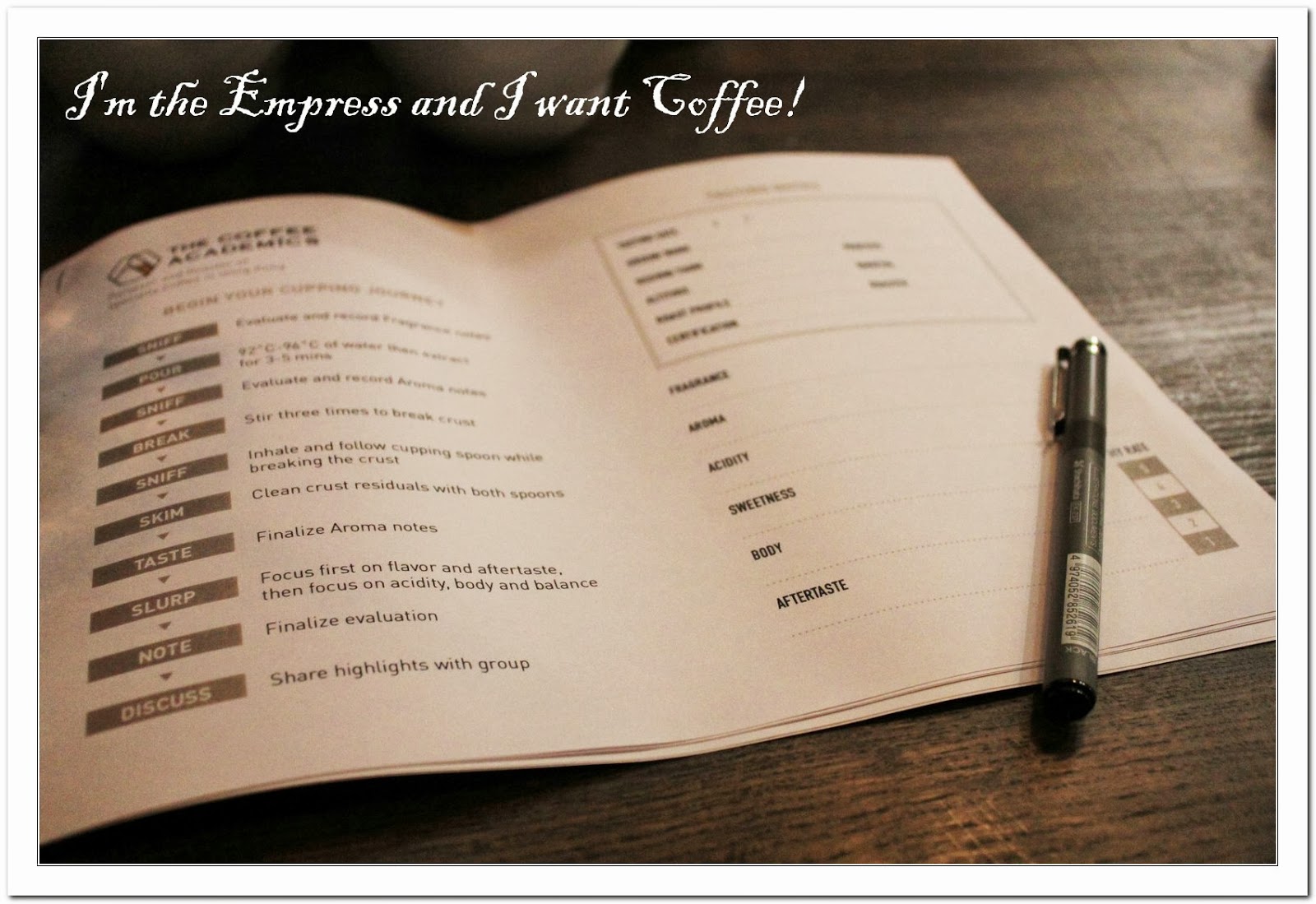
The cupping class involved coffee beans from five origins. The steps are generally the same as those I had learned. We first smelled the ground coffee and jogged down its dry aroma.


We then added hot water of 92-96 degree Celsius (the optimal temperature for brewing) to the coffee and waited for 2 minutes. It was followed by the most important step, breaking the crust, and we put our noses as close to the coffee as we could to enjoy the aroma.

Slowly clearing the foam on the surface, we tasted the coffee and judged its character. Like tasting wine, we had to inhale some air into the mouth at the same time to ensure every taste bud is in contact with the wine. The tasting part was repeated after the coffee was cooled down a bit.

The coffee I liked most that night was Columbia CoE, followed by geisha, with their character quite consistent with my favourite coffee. What surprised me most was the taste of Yirgacheffe which is usually my favourite. It was full of floral aroma as usual, but the fruitiness was not apparent. It tasted like over-extracted. As I did not have much information of the beans we used that night, I was not sure if the roast level is different from what we usually have. There are too many variables. I hope I can ask the instructor next time.
 

Cupping is a standard method of judging coffee quality, especially for coffee traders. Cupping roast enables us to spot the defects as well as the different flavour of coffee beans, be it floral, fruity, or complexity. Though crucial, the issue of cupping roast went unexplained in both cupping classes that I attended. The standard procedures for cupping are rather simple, but one needs a lot of experience to master it. All you need is a grinder, the essential equipment for home brewing, for cupping. In theory, any coffee lover who had some sort of training can practise at home. And it is time for me to practice again~